
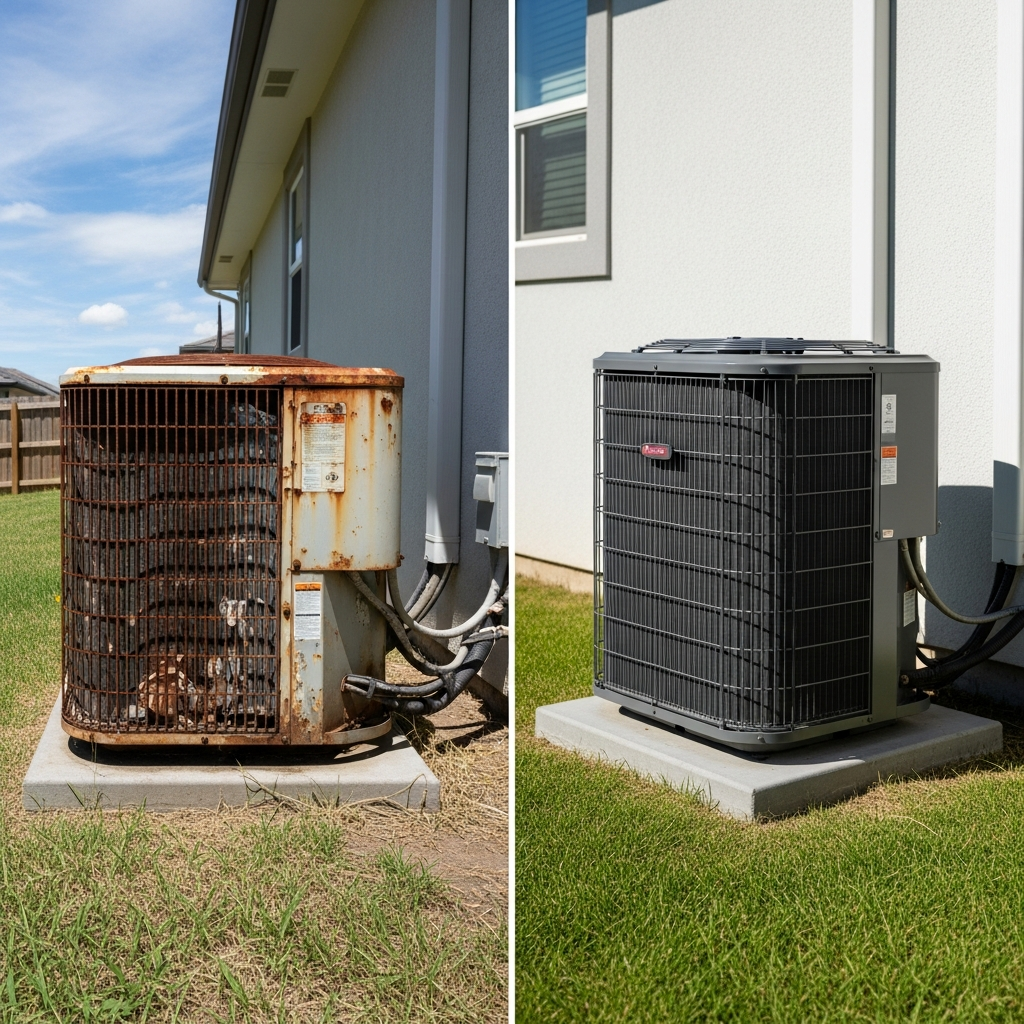
Your AC just died. It's July, it's 92°F, and you need an answer fast: fix the old one or buy a new one?
This is one of the most common conversations we have with homeowners, and there's no universal right answer. But there is a framework for thinking through it clearly, and we'll give you the same one we use when our own customers ask.
The math we actually use
There's a rule of thumb in the industry called the "5,000 rule" that we think is more useful than most of the advice out there. Here's how it works:
Multiply the age of your unit (in years) by the cost of the repair. If the result is over $5,000, lean toward replacement.
Examples:
- Unit is 8 years old, repair is $400 → 8 × $400 = $3,200 → repair makes sense
- Unit is 12 years old, repair is $500 → 12 × $500 = $6,000 → replacement territory
- Unit is 15 years old, repair is $300 → 15 × $300 = $4,500 → borderline, but you're likely to have more repairs soon
This isn't gospel, but it gives you a rational starting point. The older the unit and the bigger the repair, the less sense it makes to keep putting money into it.
What the age of your unit actually tells you
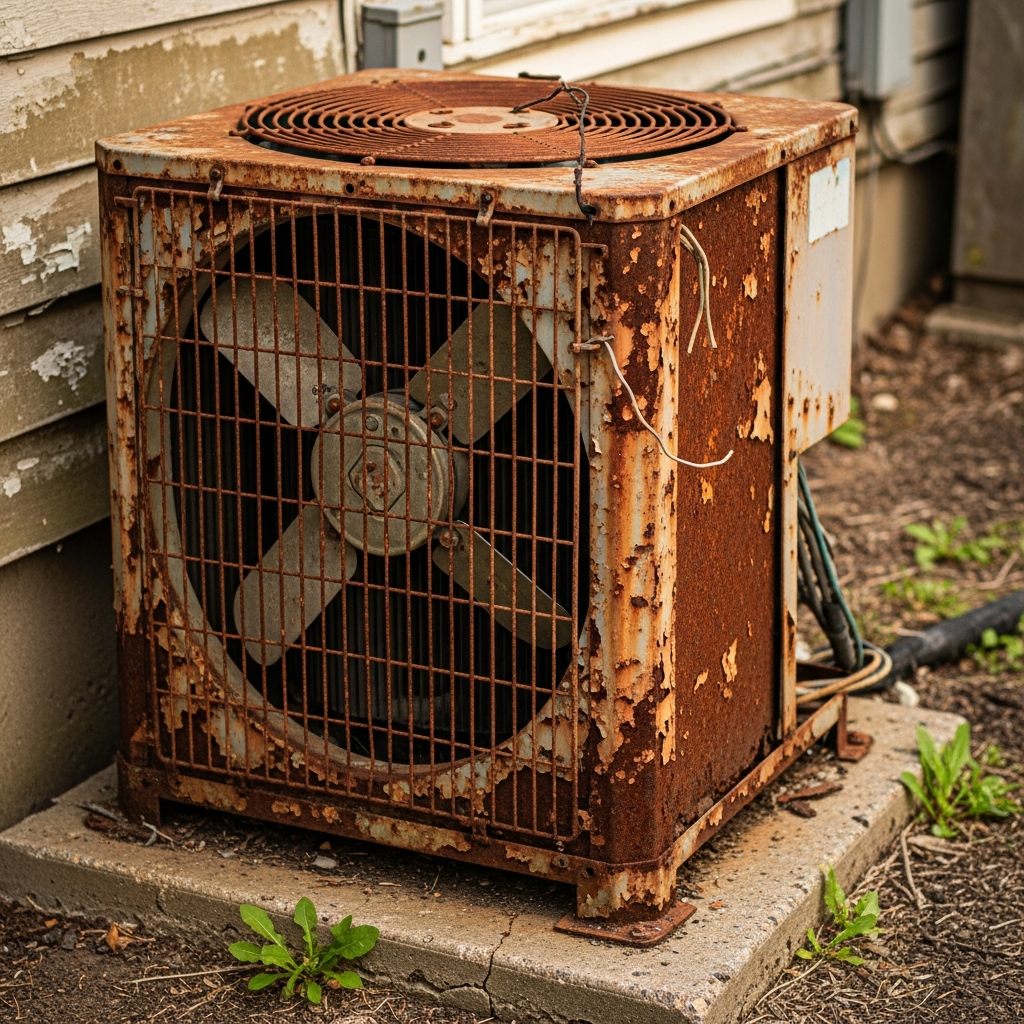
Central AC units typically last 15-20 years with maintenance, 10-15 without. But age isn't just about how many years are left — it's about efficiency.
An AC unit from 2010 was probably rated around 13 SEER. A new unit today starts at 14 SEER (the federal minimum) and readily available models go to 18-20+ SEER. SEER is like MPG for your air conditioner — higher means less electricity to produce the same cooling.
Going from 13 SEER to 16 SEER cuts your cooling electricity use by roughly 19%. On a typical Allen County home that spends $600-800 on summer cooling, that's $115-150 saved per year. Over 15 years, the efficiency savings alone can pay for a significant chunk of the new unit.
The R-22 question
If your AC was installed before 2010, it almost certainly uses R-22 refrigerant (commonly called Freon). R-22 was phased out of production in 2020 due to its ozone-depleting properties. The only R-22 available now is reclaimed or stockpiled, and the price reflects that — we've seen it as high as $150-200 per pound, and a typical recharge uses 5-10 pounds.
So if your older unit develops a refrigerant leak, you're looking at $750-2,000 just for the refrigerant — plus the cost of finding and fixing the leak. At that point, a new system with modern R-410A or R-454B refrigerant is almost always the better investment.
If your tech tells you your system "just needs a charge," ask what refrigerant it uses. If it's R-22, you need to understand the long-term cost picture before deciding.
The repair frequency test
Think back over the last two years. How many times has a technician been to your house for AC issues? If the answer is two or more, you're on a trajectory. Each repair fixes one component, but the rest of the system is the same age. When the compressor is 16 years old and the capacitor just failed, the contactor and the fan motor are also 16 years old.
We had a customer in Butler who repaired her AC three times in 18 months: a capacitor, then a contactor, then the fan motor. She spent about $900 total. When the compressor failed six months later, that was a $2,000+ repair on a unit that had already cost her $900 in the past two years. She wished she'd replaced it after the second call.
What you get with a new system that you don't get with a repair
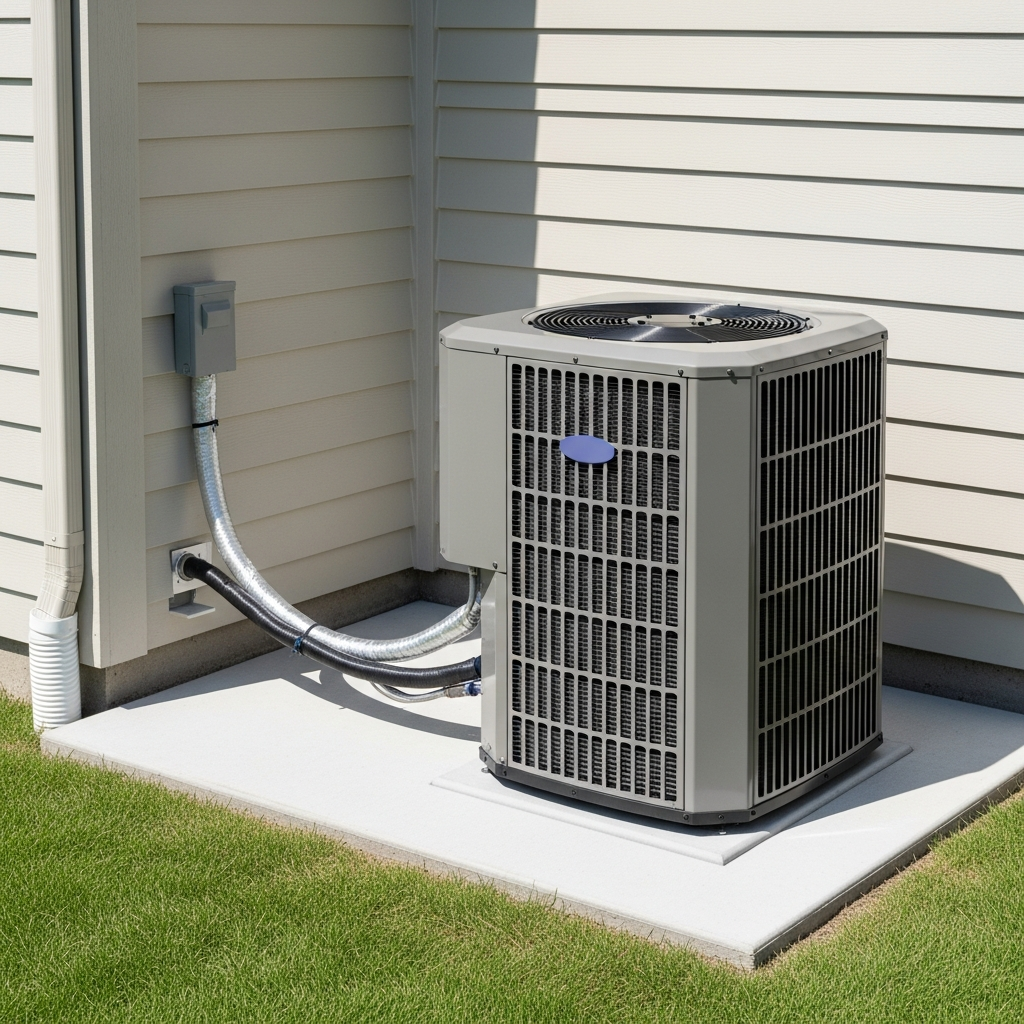
A repair gets your old unit running again. A new unit gets you:
- Higher efficiency and lower monthly bills
- A full manufacturer warranty (typically 10 years on parts)
- Quieter operation — modern units are dramatically quieter than units from even 10 years ago
- Better humidity control — variable-speed and two-stage compressors maintain more consistent comfort
- Smart thermostat integration — newer systems communicate with your thermostat for optimized performance
- Peace of mind — you're not wondering if this is the summer it finally dies
How financing changes the equation
We get it — a new AC system is $4,000-8,000 depending on the home and the equipment. That's a big number. But with financing through our partner FTL Finance, you can spread that cost into manageable monthly payments.
Here's the thing that changes people's minds: if your new unit saves you $100/month in energy costs compared to your old failing unit, and your finance payment is $120/month, the actual out-of-pocket difference is $20/month — for a brand new, warrantied, efficient system that will last another 15-20 years.
We're not saying financing is right for everyone. But it's worth running the numbers before you sink $1,500 into a repair on a unit that might need another $1,500 next summer.
What we tell people honestly
When a customer asks us whether to repair or replace, we give them our honest recommendation and explain why. We don't push replacements on units that have years of life left — that would catch up to us fast in a community this size. And we don't tell people to keep repairing a unit that's clearly done just because the repair bill is smaller today.
If you're on the fence, call us at (260) 927-6910. We'll come out, assess what's going on, and walk you through both options with real numbers. The decision is yours — we just want you to make it with good information.